
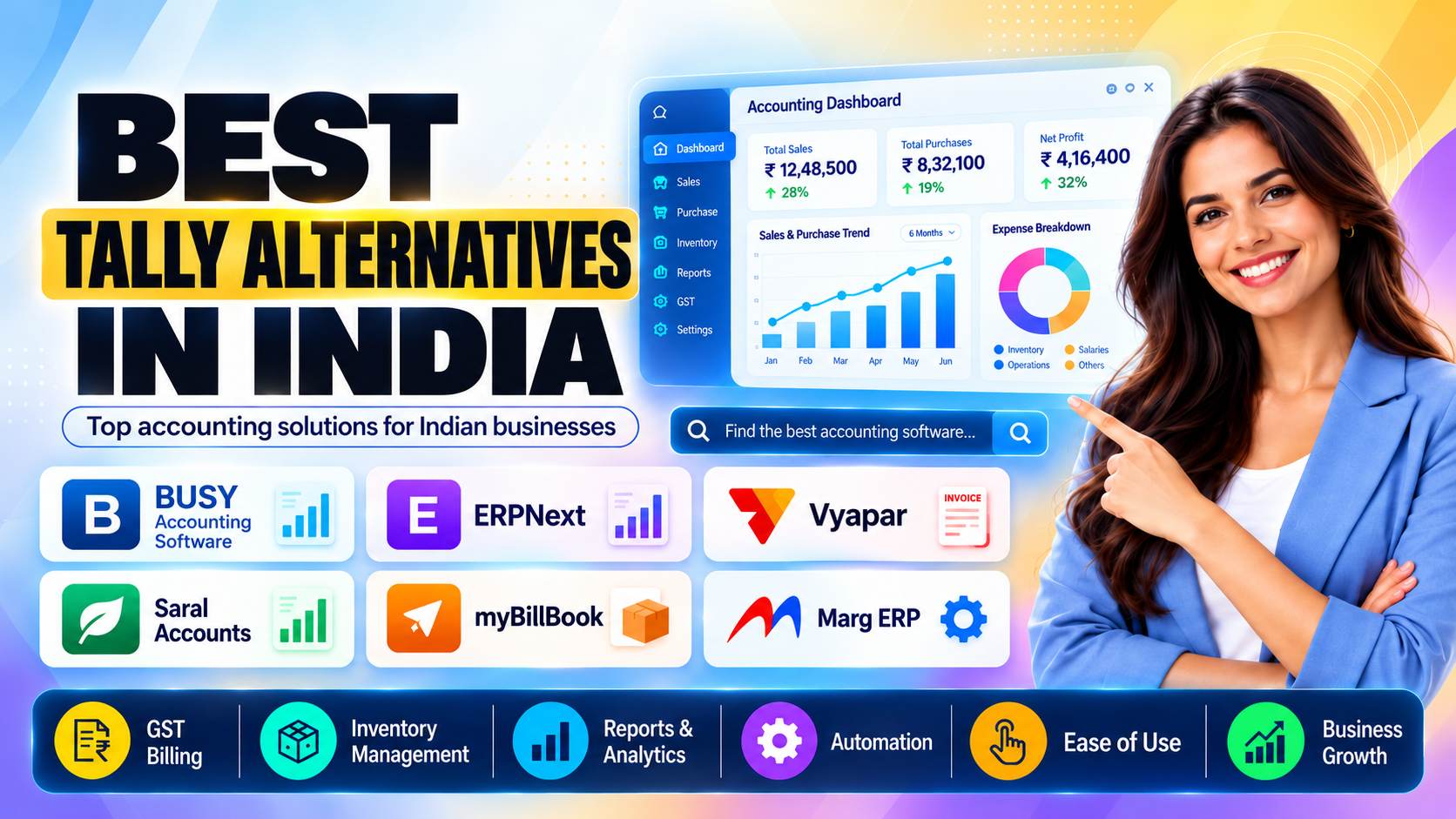
TallyPrime remains a popular accounting solution for Indian businesses, offering bookkeeping, GST management, inventory tracking, and financial reporting. However, growing businesses and Chartered Accountant (CA) firms increasingly need flexible cloud access, streamlined automation, easier collaboration, and accounting tools that support changing operational requirements.
The best TallyPrime alternatives in India offer different advantages depending on business size, industry, and accounting complexity. Some specialise in GST compliance and inventory management, while others focus on online accounting, billing automation, and integrated business management.
This guide compares seven TallyPrime alternatives in 2026, examining their features, usability, GST capabilities, cloud access, pricing, limitations, and suitability for Indian businesses and CA practices.
Key Takeaways
- Zoho Books is a strong choice for cloud accounting, GST management, automation, and collaboration with accountants.
- BUSY Accounting Software suits GST-intensive businesses requiring detailed inventory management and financial reporting.
- ERPNext is ideal for growing organisations looking to combine accounting, inventory, manufacturing, and business operations.
- Vyapar and myBillBook focus on accessible billing, stock tracking, and financial management for small businesses.
- Saral Accounts and Marg ERP offer specialised accounting, GST, inventory, and business management capabilities.
Best TallyPrime Alternatives in India at a Glance
The following comparison highlights the primary strengths, GST capabilities, and pricing of seven accounting platforms.
| Software | Best For | Key Features | Starting Price |
|---|---|---|---|
| Zoho Books | Cloud accounting and CA firms | GST, automation, collaboration | Free; paid ₹749/month* |
| BUSY | GST-intensive businesses | Reconciliation, inventory, reporting | Free; GST Smart ₹8,000/360 days |
| ERPNext | Growing SMEs and manufacturers | Accounting, ERP, workflow automation | Open-source; hosting from ₹410/month |
| Vyapar | Small businesses and retailers | GST billing, inventory, payment tracking | Free mobile option; paid plans vary |
| Saral Accounts | GST accounting and financial management | GST, reconciliation, reporting | ₹7,500/year for Bronze |
| myBillBook | Mobile-first billing and small businesses | GST invoicing, POS, inventory | Plus ₹3,490/year |
| Marg ERP | Retail, pharmacy, and distribution | Batch tracking, billing, inventory | ₹5,550 for Nano |
Pricing verified against publicly available vendor information in October 2026. Zoho Books pricing is billed annually. Amounts exclude applicable taxes unless stated otherwise. ERPNext hosting is separate from implementation and support, and Saral’s Bronze edition does not include every accounting feature available in higher editions. Promotional prices may change.
7 Best TallyPrime Alternatives in India for 2026
1. Zoho Books – Best for Cloud Accounting and CA Collaboration
Zoho Books is a cloud-based accounting platform designed for businesses that want to manage financial records, GST workflows, invoicing, and reporting through an online system. Its accessible interface and automation capabilities make it particularly relevant for SMEs and CA firms handling accounting activities remotely.
Unlike desktop-focused accounting software, Zoho Books enables authorised users to work on financial records from different locations without relying on a single office computer.
Key Features
- GST invoicing, tax reports, e-invoicing, and supported filing workflows.
- Bank reconciliation, recurring invoices, and automated payment reminders.
- Financial statements, expense management, and inventory tracking.
- Accountant access, user permissions, and approval workflows.
- Integrations with Zoho applications and supported third-party platforms.
Pricing: Zoho Books provides a free plan for eligible businesses with annual revenue not exceeding ₹25 lakh. The Standard plan costs ₹749 per organisation per month when billed annually, excluding taxes. Higher plans offer additional users and advanced capabilities.
Best for: CA firms, service businesses, and growing SMEs seeking cloud accounting, GST management, and remote collaboration.
What we like:
- Cloud access makes collaboration between accountants and business owners easier.
- GST reporting, bank reconciliation, and workflow automation support everyday accounting.
- Integrations with other Zoho applications help connect business processes.
What to keep in mind:
- Advanced automation and inventory capabilities may require higher-priced plans.
- Businesses moving from TallyPrime may need time to adjust to a different interface.
2. BUSY Accounting Software – Best for GST and Inventory Management
BUSY Accounting Software is designed for Indian businesses that require detailed financial accounting, GST compliance, and inventory management. It is particularly relevant for wholesalers, distributors, retailers, and manufacturers managing frequent transactions and complex stock movements.
For businesses accustomed to traditional accounting software, BUSY offers an extensive set of accounting and operational features while supporting additional mobile and remote-access options.
Key Features
- GST reconciliation, e-invoicing, e-way bills, and return-related workflows in eligible plans.
- Multi-godown inventory management, batch tracking, and stock valuation.
- Financial statements, ledgers, and receivables reporting.
- AI-assisted voucher scanning in BUSY Magic Smart.
- Multi-company accounting and user-based access controls.
Pricing: BUSY offers a free Express edition. BUSY Magic Smart costs ₹8,000 for 360 days, excluding GST. Its BUSY 21 Standard perpetual licence is listed at ₹16,500, with renewal and optional cloud services charged separately.
Best for: Wholesalers, distributors, manufacturers, and GST-intensive businesses managing complex inventory and accounting workflows.
What we like:
- Comprehensive GST-related accounting and reconciliation capabilities.
- Detailed inventory management, stock valuation, and multi-godown tracking.
- Flexible licensing options for different business requirements.
What to keep in mind:
- New users may require training to navigate advanced accounting features.
- Cloud hosting and certain advanced capabilities involve additional costs.
3. ERPNext – Best for Growing Businesses and Integrated ERP
ERPNext is an open-source enterprise resource planning platform that combines accounting with inventory, sales, purchasing, manufacturing, projects, and other business operations. Unlike simpler accounting applications, it provides a connected environment for managing multiple departments.
It is especially relevant for businesses looking to replace separate accounting, inventory, and operational systems with an integrated platform.
Key Features
- General ledger, invoicing, accounts payable and receivable, and financial reporting.
- Inventory, warehouse, purchasing, and manufacturing management.
- Workflow approvals, user permissions, and configurable business processes.
- Cloud deployment or self-hosting options.
- Indian GST, e-invoicing, and e-way bill workflows through the India Compliance application.
Pricing: ERPNext is open-source, with no conventional per-user software licence fee. Frappe Cloud site hosting starts at approximately ₹410 per month. Hosting, implementation, configuration, training, and support costs depend on deployment requirements.
Best for: Growing SMEs, manufacturers, and businesses seeking integrated accounting, inventory, purchasing, and operational management.
What we like:
- Combines accounting with inventory, manufacturing, and other business functions.
- Open-source architecture offers substantial customisation flexibility.
- Supports configurable workflows, permissions, and cloud deployment.
What to keep in mind:
- Implementation requires more planning than basic accounting applications.
- Indian GST features require appropriate configuration, and hosting or technical support can increase costs.
4. Vyapar – Best for Small Businesses and Retailers
Vyapar is a billing and accounting application developed for Indian small businesses, retailers, traders, and shop owners. It focuses on simplifying daily invoicing, inventory tracking, customer payments, and basic financial management.
Its mobile and desktop options make it particularly useful for business owners who want convenient billing tools without working through complex accounting procedures.
Key Features
- GST invoice creation and customisable billing formats.
- Inventory tracking and low-stock notifications.
- Customer balance management and payment reminders.
- Expense tracking and business performance reports.
- Multi-device synchronisation and e-way bill or e-invoice features in supported plans.
Best for: Small retailers, traders, shop owners, and businesses seeking simple GST billing and inventory management.
What we like:
- User-friendly billing and invoice management.
- Mobile and desktop options support everyday business activities.
- Inventory tracking and payment reminders help simplify operations.
What to keep in mind:
- Advanced accounting and synchronisation features depend on the selected plan.
- Businesses requiring complex financial reporting or multi-client accounting may need a more comprehensive solution.
5. Saral Accounts – Best for GST Accounting and Financial Management
Saral Accounts is an Indian accounting and business management platform designed for organisations handling GST invoicing, inventory, financial records, and statutory reporting. It offers different editions for businesses with varying accounting and operational needs.
Its GST-enabled accounting, bank reconciliation, and company-wise user management capabilities make it worth evaluating for businesses working closely with accountants and CA firms.
Key Features
- GST-enabled accounting and statutory reporting in supported editions.
- E-invoicing and business transaction management.
- Bank reconciliation and financial reporting.
- Inventory, stock, and service invoicing capabilities.
- Multi-user options and company-wise access controls.
Pricing: Saral Bronze starts at ₹7,500 for a single-user licence under its published annual subscription structure. Saral Gold, which includes GST-enabled accounting and bank reconciliation, is listed at ₹12,000 for a single user. Implementation and GST charges may apply.
Best for: Indian SMEs, accountants, and businesses requiring GST-enabled accounting, bank reconciliation, and financial reporting.
What we like:
- GST-related accounting and reporting capabilities in supported editions.
- Financial management, inventory, and reconciliation functions.
- Multiple editions allow businesses to select features according to their requirements.
What to keep in mind:
- Important features vary between editions.
- Businesses should verify cloud accessibility, user licensing, and implementation requirements before purchasing.
6. myBillBook – Best for GST Billing and Mobile-First Businesses
myBillBook is an Indian billing and business management platform designed for small businesses, retailers, wholesalers, and entrepreneurs. It combines invoicing, stock tracking, payment management, and basic bookkeeping in an accessible environment.
With mobile and web access, it appeals to businesses that want to handle daily transactions without adopting a more complex accounting system.
Key Features
- GST and non-GST invoicing with customisable bill formats.
- Inventory monitoring, low-stock alerts, and batch tracking.
- Customer payment tracking and outstanding balance management.
- POS billing, quotations, and purchase orders.
- Mobile and web access with accountant collaboration in supported plans.
Pricing: The myBillBook Plus plan is advertised at ₹3,490 annually, equivalent to approximately ₹291 per month when billed annually. Other plans provide additional functionality and access options.
Best for: Small businesses, retailers, wholesalers, and entrepreneurs prioritising GST invoicing and accessible billing tools.
What we like:
- Straightforward GST invoice creation and payment tracking.
- Mobile and web access support everyday business operations.
- Inventory management and billing features are useful for small retailers.
What to keep in mind:
- Advanced accounting requirements may exceed its core billing-focused capabilities.
- Some features and collaboration options are available only in selected plans.
7. Marg ERP – Best for Retail, Pharmacy, and Distribution Businesses
Marg ERP is a business management and accounting solution with a strong focus on inventory, billing, and distribution workflows. It is particularly relevant to pharmaceutical businesses, wholesalers, retailers, and organisations managing extensive product catalogues.
Its industry-oriented capabilities differentiate it from general-purpose accounting applications that concentrate primarily on bookkeeping and financial reporting.
Key Features
- GST billing and accounting functionality.
- Batch-wise inventory management and expiry-date tracking.
- Purchase, sales, and distribution management.
- Business reporting and stock movement analysis.
- Multi-user options and additional cloud-related services.
Pricing: Marg ERP Nano starts at ₹5,550, while its Basic, Silver, and Gold editions are advertised at ₹10,300, ₹13,900, and ₹26,000, respectively. Prices exclude 18% GST, and implementation or customisation may cost extra.
Best for: Pharmaceutical businesses, wholesalers, distributors, and retailers requiring detailed inventory and billing management.
What we like:
- Specialised inventory features, including batch and expiry-date tracking.
- GST billing and distribution management capabilities.
- Multiple editions support different business requirements.
What to keep in mind:
- Configuration and training may be necessary for complex workflows.
- Additional users, customisation, and cloud-related services can increase overall costs.
How to Choose the Right TallyPrime Alternative
Choosing accounting software depends on business size, daily transaction volumes, compliance requirements, and the complexity of existing financial processes. Before replacing TallyPrime, businesses and CA firms should consider five important factors.
1. GST Compliance and Reporting
Check whether the platform supports relevant GST processes, including GSTR-1, GSTR-3B, e-invoicing, e-way bills, and reconciliation. Not every feature is available in every plan, and businesses remain responsible for correct compliance.
2. Cloud Access and Collaboration
CA firms working with multiple clients should prioritise secure accountant access, user permissions, audit trails, and remote collaboration. Zoho Books offers cloud-native accounting, while ERPNext provides configurable cloud deployment. Desktop-oriented platforms may require additional services for remote access.
3. Automation and Integrations
Look for meaningful time-saving features such as bank reconciliation, recurring invoices, payment reminders, automated document processing, and integrations with existing business systems. Verify whether advertised AI capabilities are genuinely AI-assisted or standard workflow automation.
4. Pricing and Scalability
Compare the overall cost, including subscriptions, licence fees, extra users, hosting, implementation, support, and renewal charges. Consider whether the platform can accommodate future transaction volumes and business expansion.
5. Migration from TallyPrime
Before migrating, confirm which records can be transferred, including customer and supplier details, chart of accounts, opening balances, outstanding invoices, and inventory. Back up existing records and reconcile important financial reports after importing the data.
FAQs
Q.1. What is the best alternative to TallyPrime in India?
Zoho Books, BUSY, ERPNext, Vyapar, Saral Accounts, myBillBook, and Marg ERP are relevant alternatives. Zoho Books is suitable for cloud accounting, BUSY for GST-intensive operations, and ERPNext for integrated business management. The right choice depends on the organisation’s accounting requirements.
Q.2. Which TallyPrime alternative is best for CA firms?
Zoho Books is a strong option for CA firms requiring cloud collaboration, accountant access, financial reporting, and GST workflows. BUSY and Saral Accounts may also suit particular client accounting requirements. Firms should evaluate multi-company support, audit trails, permissions, and data portability.
Q.3. Is there a free alternative to TallyPrime?
Yes. Zoho Books offers a free plan for eligible small businesses, BUSY provides a free Express edition, and ERPNext is open-source. However, feature restrictions, hosting expenses, and implementation costs can affect the suitability of these options.
Q.4. Which accounting software supports GST compliance and cloud access?
Zoho Books provides cloud accounting with GST features. ERPNext supports Indian statutory requirements through its India Compliance application. Other platforms offer GST functionality alongside varying desktop, mobile, cloud, or remotely hosted access arrangements. Businesses should verify the relevant features before subscribing.
Q.5. Can businesses migrate accounting data from TallyPrime to another platform?
Yes, but migration compatibility depends on the destination software. Businesses may be able to import account masters, opening balances, inventory, and transaction data using supported formats or migration tools. Financial reconciliation and secure backups are essential before completing the transition.
Final Verdict: Which TallyPrime Alternative Is Best?
The best TallyPrime alternative depends on whether a business prioritises advanced accounting, cloud collaboration, simpler billing, or integrated operational management.
For CA firms and cloud-focused businesses, Zoho Books offers a strong combination of financial reporting, GST features, and remote collaboration. BUSY is particularly suitable for businesses with complex inventory and GST-related processes, while ERPNext is worth considering for organisations that require integrated accounting, manufacturing, and operational systems.
Smaller retailers and independent businesses may prefer Vyapar or myBillBook for accessible invoicing and inventory tracking. Saral Accounts is relevant for GST-focused accounting requirements, whereas Marg ERP stands out for inventory-intensive retail, pharmacy, and distribution environments.
Businesses should shortlist platforms based on their specific requirements, evaluate the relevant subscription or licence, and test essential workflows before transferring accounting records.